
Otto Benson Interview
My conversation with Otto directly after he played a set of largely unreleased music at Bottom of the Hill in San Francisco on October 8, 2025

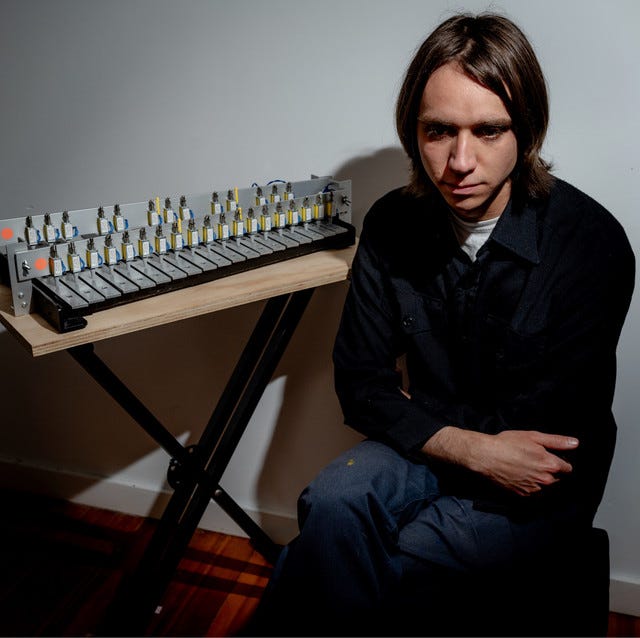
★ How was your day today?
It was pretty long. We drove in from Los Angeles. We got up pretty early. I didn’t really have breakfast…which is an important part of my day. So I was a little cranky. But we got sushi here, so now I’m riding the sushi vibe.
I was gonna ask if you ate anything good on tour. What kind of roll did you get?
The sushi was maybe the best meal so far. I got a yellowtail and scallion and mushroom roll.
★ Was this your first time playing a show in SF? I know you mentioned you played a show here with Porches before.
Yeah, this is my first time playing my own music here in San Francisco. I played bass in Porches last year for their North American tour and we came here and played at Bimbo’s 365 Club, which was maybe my favorite venue that I’ve ever played at or been to.
What did you like about it?
It’s all like, original 1930’s…they’ve kept most of the details pretty accurate, I think, to the original design and construction of that place. I think it’s owned by the same family, like Bimbo’s great-grandchildren or grandchildren?
That’s awesome. Is it a music venue or a bar or both?
It’s both. It’s incredible.
★ Well, it was very exciting to finally hear you play here after so many years of waiting. How did you get connected with Will [Pacquin] for this tour? Did it take much convincing?
Will’s a mutual friend of mine. We met through a friend of mine, Arlo, who is a really amazing guitarist. Will knows Arlo from Cambridge, like the Boston area.
You went to UMass, right?
Yeah, but that’s like Western Mass, which is kind of out of that scene. I wasn’t in Boston very much. It’s more rural, where I was.
Like a college town?
Yeah, like a college town and a lot of farmland. There’re a bunch of colleges over there, it’s kind of like a college conglomerate or something. But a really special place for me…we’re talking about Will?
(laughs) Yeah, sorry—how’d you get connected and decide to go on tour with him?
I think he got introduced to my music by our friend Arlo. And then he came to my show at Scribble a few months back.
In LA?
In Los Angeles. Yeah, he said what’s up to me and I got his contact and saw that he also had a similar…we both have TikTok hits, songs that are really big on TikTok, or algorithmically favorable. I’ve been slowly meeting more people who have that kind of success, but it’s weird and really rare to find other musicians who get that kind of success. I take a lot of issue with this being a standard of how artists are making a living these days—making algorithmically favorable artwork. A lot of what I’m doing now is trying to resist that in ways. But in ways you can’t…what’s the analogy…you kind of just have to flow with the current sometimes.
I appreciate that it seems like you don’t double down or play into what gets boosted by the algorithm.
Thanks! I try to do, like, just enough.
Yeah, the algorithm sucks. Sometimes the music is genuinely good, though, as with you and Will. And Duster, who were one of my favorite bands.
You wanna know something funny, I used to listen to Duster on my iPod while I was making all my Memo Boy stuff.
I can see it!
And now it’s like weirdly…I don’t know, they’re in the same realm. On the internet, it’s strange how these things happen sometimes.
★ Songs Before Bed is seriously one of my favorite albums ever. I think that more music should contain glockenspiel. Did you consider at all busting out the glockenspiel for this tour? I know it might’ve been impractical since it’s rather large.
Yeah, I’ve been considering it. I kind of have put my glockenspiel project on hold. I think just the labor involved in personally bringing that thing around, maintaining it, and—when I would bring it to venues—pissing off the sound staff…it became a really delicate thing, that I do want to continue doing. But after doing that for a while, I wanted to lean into a more human expression and connection with people. I think to an extent, in making a robotic project, I was trying to maybe make fun of or make a bit out of backing tracks and digital music and that awkward interaction between a human performer and digital accompaniment. My sincere belief is that human music, human connection through music is…I don’t know, that’s all that I’m really focused on. It’s the core of the…you can call it a spiritual thing, or cosmic connection that music presents. And I think that gets lost when digital technology comes between us. I think it can enhance [but] there’s an awkward interaction. Recently, my stance has been to just shed it completely and instead bear my heart with acoustic and singing music.
Was this tour your first experimentation into not using a laptop and not using anything more electronic?
Kind of, yeah! I started taking gigs where I would just show up with a guitar. I mean, I’ve been doing it for a little while but it used to suck, like I was really bad at it. I would show up to places and it would be really awkward, and I’d kind of make a fool of myself. Eventually, I started to figure out what things people were responding to, and building up a way of connecting with people. And then I moved across the country and pretty much had no gear; I was borrowing people’s equipment and bought a Ditto Looper, like the really cheap one-button looper.
★ Your music has often and long been guitar based. When did you start playing guitar?
I started playing guitar when I was maybe 10 years old. My parents were very supportive of my music interests.
Were they big on music [when you were] growing up?
They definitely were. They aren’t musicians themselves but they’re visual artists. Their lives and practices are informed by music in a really deep way. My dad would play a lot of Kraftwerk and ‘Neu!’ My parents were really obsessed with Germany.
Like German electronic music or Germany in general?
Like, post-war Germany. The kind of modern, industrial, new ways of thinking, like Bauhaus. Even beyond that, though; they really like a lot of minimalist art and minimal music. So I grew up listening to a lot of really minimal music, and kind of [had] a personal permission to approach things with a more minimal intention. The first songs, which aren’t out there anymore, that I released on the internet or even recorded were just pads and a bunch of notes sustained for, I don’t know, ten minutes or something. I didn’t really know what ambient music was, but I was essentially making ambient music, at first. And that’s kind of the lens they gave me.
This is kind of random but is Basshunter German? Do you listen to Basshunter at all? [Editor’s note: Basshunter is Swedish]
Um, I’m vaguely familiar.
He made DotA.
I don’t really listen to that. But I do appreciate that kind of music. Is that in like the “Donk” or Gabber realm?
Yeah, for sure.
I really like that kind of music.
★ On the topic of early music endeavors, what can you tell me about Joanne Bilaud? That’s probably the earliest pseudonym of yours I could find.
Joanne Bliaud?
Bliaud! Oh, is that how you pronounce it!?
That’s how I pronounce it. I had a main Soundcloud account, and that started to collect a lot of followers…it was this main account that was building a following and a lot of eyes on the work I was doing. I just wanted personal outlets to explore other ideas. Once you create a musical identity on the internet, usually people will hold you to that identity in kind of an intense [way]. It can create a weird, toxic working relationship.
In a way, you’re incentivized to lean into a certain sound more.
Yeah, or go deeper into something you’ve already done. I felt like making new accounts, like the Joanne one—they were opportunities to have a blank slate. I think I make the best things when I think that nobody else is watching me. It was like creating a head space such that no eyes were on me or on that account, for a while. Then it attracts a certain amount of attention, people figure out it’s me, then it’s over, and I have to figure out how else to go about…I don’t know, it’s always like I’m running away from having any perception that other people are listening. My practice is very secret.
Yeah, I can see that. It’s fun to track all of your music under the different names. I noticed that you decided to dissolve your other stage names, like Pudding Club, Memo Boy, etc., and now just go under Otto Benson.
Yeah, it just became the easiest. People were calling me Otto Benson anyway and were tracking me down no matter what I changed my name to. Now I’m maybe trying to have that privacy with individual albums. I feel like I’ve earned a reputation at this point for doing something pretty different each time I make a record, for better or worse.
★ I want to go back and talk about the glockenspiel because, although it’s on the backburner for now, I just find it really beautiful and interesting. I was reading your documentation on the glockenspiel, and you wrote that, at times, the line between you controlling your computer and your computer controlling you feels fuzzy at times. That reminded me of this essay by Donna Haraway called Cyborg Manifesto. I was wondering if you’ve heard of it.
Yeah! I read it, or tried to.
Yeah, same. I’ve read parts of it.
It’s a beautiful document.
Can you remember when or why you decided to read it?
I read it in college. I took a really great class. Unfortunately, it was over Zoom, it was the beginning of the pandemic. I took an art class—this was like my last semester of my senior year, I was kind of just filling gaps. We read that and a bunch of really great essays. There was a lot that I responded to. I got really into the idea that “technology” and engineering are born from a masculine, reproductive envy that men have. I just related to that somehow. I feel like songs are little babies, in a way. They have this insane life that they live. They grow and have lives of their own. People interact with them and have whole relationships that are so beyond anything that I would have ever planned for. And also just the practice of engineering being a very male dominated field with a lot of really strange…to me, kind of idiot things that industrial, military and engineering efforts are striving towards. I feel like they’re coming from a bunch of really frustrated, young baby men who wanna watch the world burn or something…and hate that they can’t create children? (laughs) I don’t really know what I’m talking about. But that was one realm of that reading that I [took away].
A lot of what I read in that essay resonates with me. One connection between the essay and your music I’ve been thinking of was a point she made about how microelectronics have become so ubiquitous and kind of “invisible” in our environment that they’ve essentially become “nonphysical,” and thus the line between nonphysical and physical has become blurred. With the [MIDI] glockenspiel, you’ve created this very antiquated, very “physical” machine with “nonphysical” microelectronics. It’s a really interesting, funny, quirky, sort of oxymoronic device through this lens. I find it very cool.
I agree with you. There’s also something really silly to me—when you show up to venues, the end destination—or even [with] a recording—is the speakers that are presenting the music. So even when I bring the glockenspiel to venues, you can only hear that device if you’re right next to it. So I could never really perform alongside it in environments beyond like a close friend or something. If I wanna share it, I have to put it through a speaker. That’s kind of what’s driven me away from it. It’s trapped within the restraints of speakers and microphones and then it’s like…why even do something like that?... There’s something in there. I’m still figuring out what I think about it even. It is based on—or, I didn’t know a lot about them, but I started to learn a lot more about band organs in the process of building it. There’s a very long tradition of people making mechanical instruments, self-playing instruments. I guess my point is that it’s not really anything new! For me, I’m continuing that legacy [but] with solid state electronics, with microcontrollers, and not pneumatics and air pumps and stuff like that.
★ Do you have any other projects you’re working on?
Right now, all of my attention is into my guitar playing and my singing. Singing is the biggest frontier of my personal development as an artist. I would describe the experience of bringing around an electronic glockenspiel as a “limb extension” of my own body—I’m trying to create an extra limb to play melodies and parts that I couldn’t on my own. It’s like a prosthetic limb. Singing is like the core of my body. It’s very related to my breath, it’s very centered in my being. Being out in the world of electronics, it led me deeper within myself. Now, I’ve gotten really into breathwork, more into meditation, using all these different technologies to control my breath a little more and get better at singing. I’m practicing my singing and also accepting my singing for what it is, in the same way that I had to accept the range of the glockenspiel for what it was. Guitar is kind of the same, as well. Like, it’s just my hands! You’re just hearing my hands running on a couple strings. I don’t know, it’s pretty…
That’s beautiful!
Thanks!
★ You wrote on your website about how one of the main goals with Bobbery was to sonify trash and industrial waste through electronic music. I was curious if you have reference points or inspirations for this. Not that you’d be comparing these other artists to trash and industrial waste.
I don’t know if I could pinpoint specific artists. I really like this guy Rolando Simmons. He makes really beautiful, melodic electronic music that I was trying to maybe approximate when I made a lot of that music. I would say that music is also informed by hyperpop and the anti-consumerist sentiments of SOPHIE. That was a lot of what I was listening to in college when I made that. The direction of hyperpop is different now.
It was co-opted by big labels and Spotify.
A lot of genres that seek to interrogate an idea usually end up just supporting that idea. So, right now, these days I just lean into being really sincere.
I wanted to ask that because I also love the sound of trash and industrialism. And, you know, Shellac and Big Black are some of my favorite bands, and Bobbery reminds me in a weird way of their sound but in electronic form.
That’s beautiful! I hadn’t really made that connection. I also just love garbage physically and visually. I grew up in New York and there’s trash everywhere on the street like everyday. I would look at it all the time. I find a lot of really beautiful things in the trash. Thankfully I don’t have to dumpster dive to get by or anything but I do browse the dumpster, I do take a look and find uses for things people are leaving behind. Within that, there’s a whole aesthetic of discomfort and dirtiness and stinkiness, and I wanted to put that all into a musical language and throw people into the dumpster with me, and we’re both, you know, poking around in the trash or picking up litter and looking at the colors.
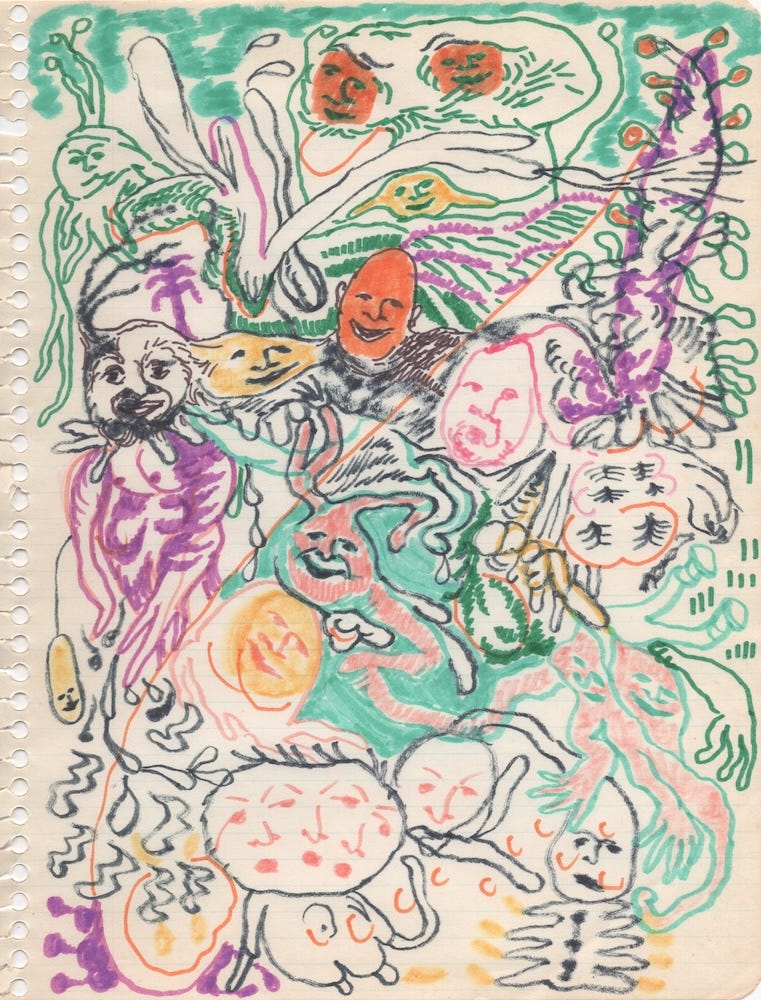
★ Your artwork is also incredible. I like that they’re often filled with smiling faces. Is there something sinister behind all these faces?
For me it’s about nondualism. Do you know what that is?
No, could you explain?
In Eastern mysticism…I mean, I’m not an expert in this, but generally, I believe that everything is connected, or that there’s a continuum that exists between me and everything that I’m conscious of. So like, plants have a…there’s a soul in there. Even on a molecular level, everything has some kind of consciousness and shared consciousness and you can interact with things and they will respond to you. Instruments—like we were talking about the glockenspiel, or my guitar, or whatever—they all have a soul and an identity. So putting a face on something, to me, is a visual representation of that relationship.
★ Do you have a favorite emoji?
Recently it’s been the hibiscus flower.
I’ve been using the “smirking cat” a lot recently.
Oh yeah, I love the cats. Like the cat crying.
★ Thoughts on Benson Boone?
I don’t really know much about him, except that we share a name. And he’s also a white man, right?
Yeah. He made that one song (singing): “I want you, I need you right now.”
If I heard it, I’d know it.
★ I noticed that your last three projects were each released exactly one year apart on New Year’s Eve. Can we anticipate that trend to continue this year?
That’s my goal. I mean, be nice to me. (laughs) I’m one person putting out these records and I’m gonna try to keep it that way, so it’s a lot of work. I like New Year’s Eve releases, I think it’s a really silly time to release music. It can be a lonely evening for a lot of folks and I want to have some kind of a presence—whether or not you want it—on the internet, for that evening.
An audio recording of our conversation along with a guest mix by Otto was aired on Lower Grand Radio on October 22, 2025.
yay yoppeee yippeee yay yay
awesome! so cool! great! huzzah! joyous! wonderful